


지난 광주비엔날레
The 9th Gwangju Biennale
- Participating Countries
- : 40
- Artists
- : 92
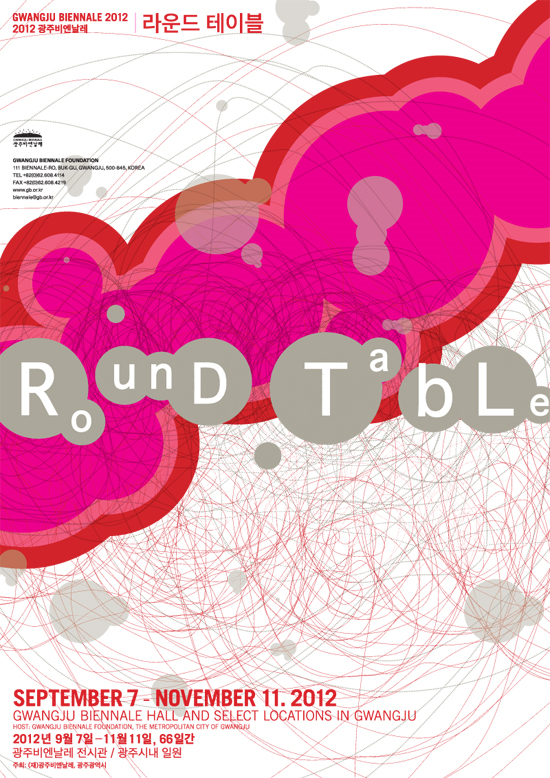
Duration of Event: September 7 ~ November 11, 2012
While it operates simultaneously on many levels, one thing is quite clear: ROUNDTABLE, the 9th Gwangju Biennale, is not about unanimity. It is instead an open-ended series of collaborations that require active participation and individual responsibility, resulting in a multiplicity of voice, as well as opportunities for cross-contamination.
Beyond metaphor, ROUNDTABLE simultaneously describes the working relationship of the 2012 Gwangju Biennale’s six Co-Artistic Directors (Nancy Adajania, Wassan Al-Khudhairi, Mami Kataoka, Sunjung Kim, Carol Yinghua Lu, and Alia Swastika), the conversational interaction of its six sub-themes, and its non-linear structure.
Overview
 | ROUNDTABLE :
The 9th Gwangju Biennale While it operates simultaneously on many levels, one thing is quite clear: ROUNDTABLE, the 9th Gwangju Biennale, is not about unanimity. It is instead an open-ended series of collaborations that require active participation and individual responsibility, resulting in a multiplicity of voice, as well as opportunities for cross-contamination. Beyond metaphor, ROUNDTABLE simultaneously describes the working relationship of the 2012 Gwangju Biennale’s six Co-Artistic Directors, the conversational interaction of its six sub-themes, and its non-linear structure. Historically, the roundtable is associated with the political summit, where various agendas are brought together for group consideration. It could also evoke the traditional Korean image of the roundtable, the duriban, around which people eat communally. In this vein the six Co-Artistic Directors - Nancy Adajania, Wassan Al-Khudhairi, Mami Kataoka, Sunjung Kim, Carol Yinghua Lu, and Alia Swastika- chose to engage with the practice of the collective as a nonhierarchical organizational alternative. The process echoes and intersects with various regional histories and movements, challenging the Co-Artistic Directors to consider diverse forms of community and various contexts of belonging. The result is not pre-determined by any group identity or shared quality, and instead reflects a shifting, organic relationship of ideas. This approach is also expressed through the six sub-themes that form the core of the ROUNDTABLE. By design, the sub-themes circle around one another, overlapping, and at times taking oppositional views on the role of the individual or of the collective. Within the overarching framework of the ROUNDTABLE, they invite us to rethink history as a series of malleable junctures, to consider the tension between belonging and anonymity, and the affects that temporality, spatiality and mobility have on the collective. The Co-Artistic Directors describe their process in this manner: “As individuals working together, we could not have a single perspective, and instead it became about finding a connecting point. Both curator and audience may not relate in the same way to all of the artists, however we can find a point of connection within the themes.” The act of curation is thus a synthesis - a series of collisions that perhaps leads to transformation.
|

 | Logging In and Out of Collectivity: How do we signalise those sparking points in cultural practice, where an interplay between individual artistic choice and collective civic volition brings about a burst of critical agency? Navigating between evolving constructs of the 'individual’ and the 'collective’, cultural producers may at times articulate themselves as distributed subjectivities; subscribe to notions of utopia lost or betrayed; or retrieve erased protocols of critical citizenship. Specific tropes may be discerned here: the entanglement of seemingly dissimilar histories at a moment of crisis, or the rehearsal of conflicts and resolutions originally identified with one society unfolding in another, often under the sign of resistance or revolution. Through an improvisational methodology, ROUNDTABLE, negotiates the transitive relationship between a participant self and various conceptions of solidarity. |
 | Re-visiting History Jean Fisher posited that, “to write of depicting or representing history is to imply that history is some kind of object with identifiable boundaries that distinguish it from other objects…” ROUNDTABLE responds to this statement with a series of questions: How is history used? Re-used? What is our relationship to history? How do we remember? Why do we remember specific things? Is using history as an ‘object’ a way in which we define ourselves in today’s world, with all its dramatic changes?earthquakes, tsunamis, wars, and civil uprisings?and how do we revisit history to remember when and why these events happened before? |
 | Transient Encounters Recognizing the temporary and circulatory nature of biennales, which by definition reflect shifting curatorial themes and structures in rotation, leads to a broader possibility of discourse. Life is not about the solid stabilities that historical constructs might suggest; prevailing global trends and recent developments are only fragments within a larger history of the universe. Living requires facing continuous change and openness to the experience of transformation and transient encounters. ROUNDTABLE realizes the diverse interconnectivities of different contexts within which we can find our own temporal positioning. As Buddhism suggests ‘everything is transient’?we are challenged to question what needs to be inherited and what must be constructed on its own terms. |
 | Intimacy, Autonomy and Anonymity Woven from multiple layers of histories that enclose possibilities of intimacy, autonomy and anonymity, the urban sphere emerges from beneath a city's surface. Modern Gwangju has largely been constructed through definitions that establish specific protagonists and operate within the realm of monumental narratives, often as a reflection of its role in the civil uprising that led to the reawakening of Korean democracy. Through residencies and new commissions, ROUNDTABLE provides artists the opportunity to look beyond such grand political and social narratives to reveal overlooked histories and traces of the lives of its inhabitants. |
 | Back to the Individual Experience The debordering and loosening of economic, sovereign, social, cultural and historic frameworks by digitization, global trade and political movements is challenging our ideological and national logics. It is time to consider the conditions in which transformative forces inspired and motivated by the individual are incubated on a societal, philosophical and artistic level. ROUNDTABLE speculates about alternative orders and logics of connectivity beyond the existing and dominant neoliberal economic and political discourses by recognizing the value of the individual spirit in remaking regional and global histories. |
 | Impact of Mobility on Space and Time Modern realities of mobility are transformative; the simultaneous loosening / tightening of borders and geo-political notions, combined with the increasing flows of goods, people and information as a result of globalization have made defining border regions exponentially more complicated. The historical meaning of borders and their impact on social phenomena must be reframed and rediscovered. In many cases their traditional role, to create barriers and to contain, is replaced by a bridging function, enabling contact. ROUNDTABLE recognizes artists as an integral part of this odyssey and invites an investigation of different notions or interpretations of mobility, spatiality, and temporality - time/space, here/there, now/then - towards a new, inherently liminal horizon. |